|
LELLA & GIANNI MORRA Fine Japanese Prints, Illustrated Books and Works of Art |
|
 HIRASE
YOICHIRO AND HIS WOODBLOCK
PUBLICATIONS
HIRASE
YOICHIRO AND HIS WOODBLOCK
PUBLICATIONSHirase Yoichiro (1859-1925) was a collector, dealer and scholar of Malacology active in Kyoto at the beginning of 20th century. Hirase began his collection of shells around 1898 and in 1907 published the first issue of the “Conchological Magazine”. In 1913 he opened a museum devoted to shells in the Okazaki area near the Kyoto zoo. Hirase became internationally well-known, selling shells to collectors and museums in Europe and the United States.
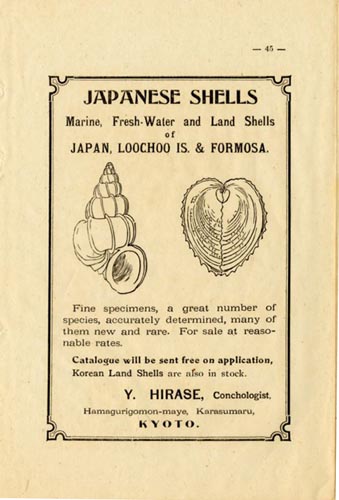


The Hirase's advertising in The Official Catalogue.
Kyoto Commercial Museum. 1910.
The Museum' handbook "The Album of The Hirase Concological Museum". 1915.
Hirase's portrait and the Museum's building illustrated in the Museum's
handbook.
A shell pattern book
Among his many scientific publications, Hirase published two woodblock print books through the leading Kyoto art publisher Unsodo. The first one, the single-volume Kaigara Danmen Zuan, in traditional Japanese string binding, is dated Taisho 2 (1913) and, except for two fine colour plates, comprises black and white decorative patterns made from shell sections. It was presented in the publisher’s catalogue, as a “design book” (Unsodo no. 652). The title on the cover is followed by the number ichi (one) but no other volume are known as a sequel for this work.
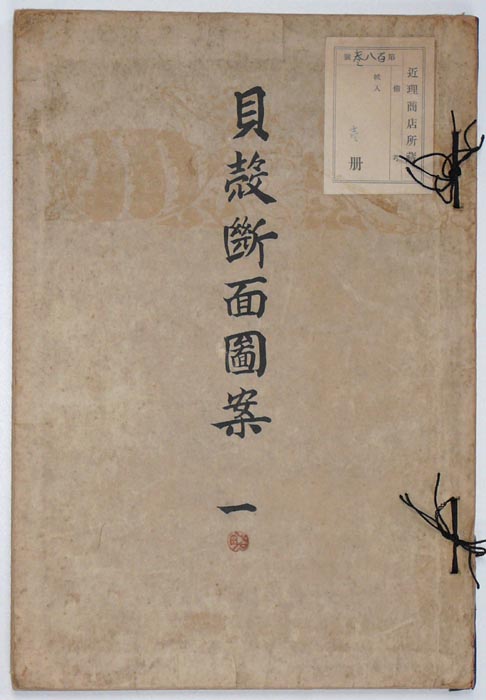

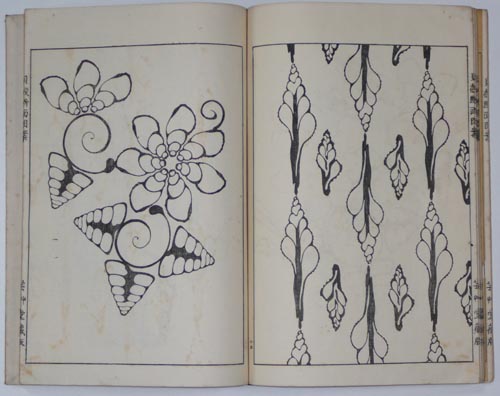
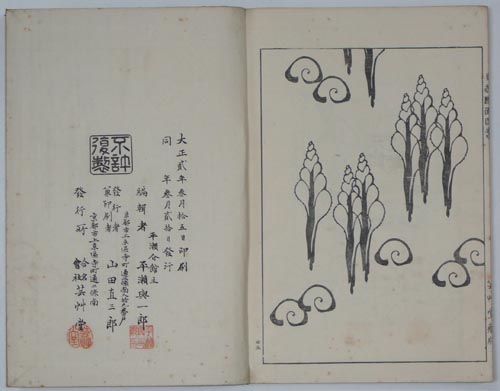
The "Kaigara Danmen Zuan". One volume. Kyoto,
Unsodo, 1913.
The cover, illustrations and colophon.
An ambitious publication
The
second woodblock publication titled Kai Chigusa (One Thousand Kinds of Shells)
was much more ambitious.
All the plates were in colour and the shells were
depicted in an accurate, realistic way. Ten orihon style volumes were planned, to
illustrate 1000 shells as announced in the title, but due to later financial
restraints only four volumes were published. The first one appeared in 1914,
the second and third in 1915 and the fourth in 1922. Each concertina volume
has orange silk cover and show 100
shells illustrated on twenty plates.
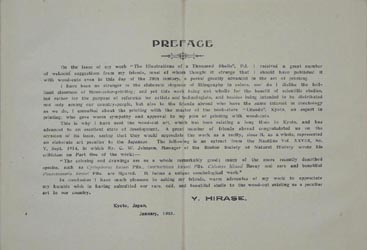
In
the English preface to the second volume of Kai Chigusa, Hirase
explains the reason he chose the old traditional woodblock printing process,
“a peculiar art of our country”, instead of modern colour lithography or
three-color printing.
He
further proposed his book as "...being not wholly for the benefit of
scientific studies but rather for the purpose of reference for artists
and technologists.."
This publication was also
introduced in the publisher’s catalogue as “for designers’ companion” (Unsodo
no. 653 with title Kai Sen Shu).
It is clear that both author and publisher
were interested in reaching a wider audience beyond the shell collectors,
and the use of woodblock printing was an additional merit for their
publications.

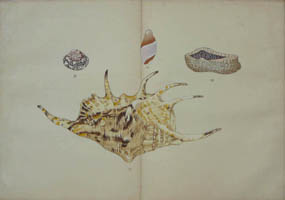
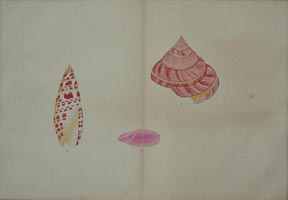
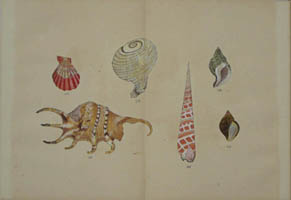
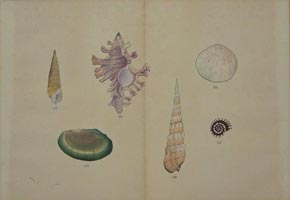
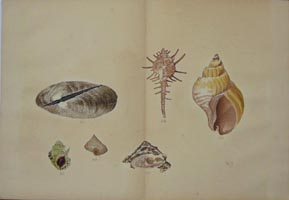
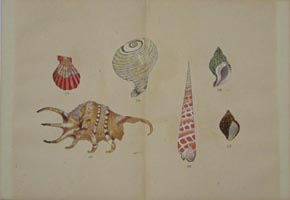
The "Kai Chigusa". Four volumes. Kyoto, Unsodo, 1914-15-22.
The press run of Kai Chigusa
The exact number of printings and copies produced of Kai Chigusa is known.
This is of special interest for anyone interested in
Japanese woodblock books and gives an insight into the production terms of
the publisher Unsodo.
In the article “Dates of publication of Yoichiro
Hirase’s Kai Chigusa” by Paul Callomon of the Academy of Natural Sciences of
Philadelphia, the author reproduces a detailed list of all printings and dates of
publication obtained from Unsodo by an American scientist, Alvin R. Cahn, in
1957.
The
press run and dates can be summarized as follows:
First volume: eight printings from 1914 to 1937and a total of 880 copies.
Second volume: six printings
from 1915 to 1935 and 750 copies.
Third volume: five printings from 1915 to 1933 and
650 copies.
Fourth volume: three printings from 1922 to 1935 and 400 copies.
The
press run varies from 300 copies for the first printing of all four volumes
to 100, 50 and 30 copies for later printings.
The 30 copies made in 1935 and
1937 seem to be a very small production runs, but even if they were not done
on commission, it was probably still profitable for Unsodo to do a kind of
“print-on–demand” publishing.
Literature:
Paul Callomon, Dates of publication of Yoichiro Hirase’s Kai
Chigusa in The Nautilus 118, p. 175-176, 2004.
Paul Callomon and Akira Tada,
Yoichiro Hirase and his role in Japanese Malacology in Bulletin of the
Nishinomiya Shell Museum no. 4. Nishinomiya 2006.
Yamada Unsodo Co., An Illustrated Catalogue of Books, Periodicals & Albums for Art & Artistic Designs. Kyoto 1915.
Designed & Written by Lella & Gianni Morra ©
2011
(All Rights Reserved)